

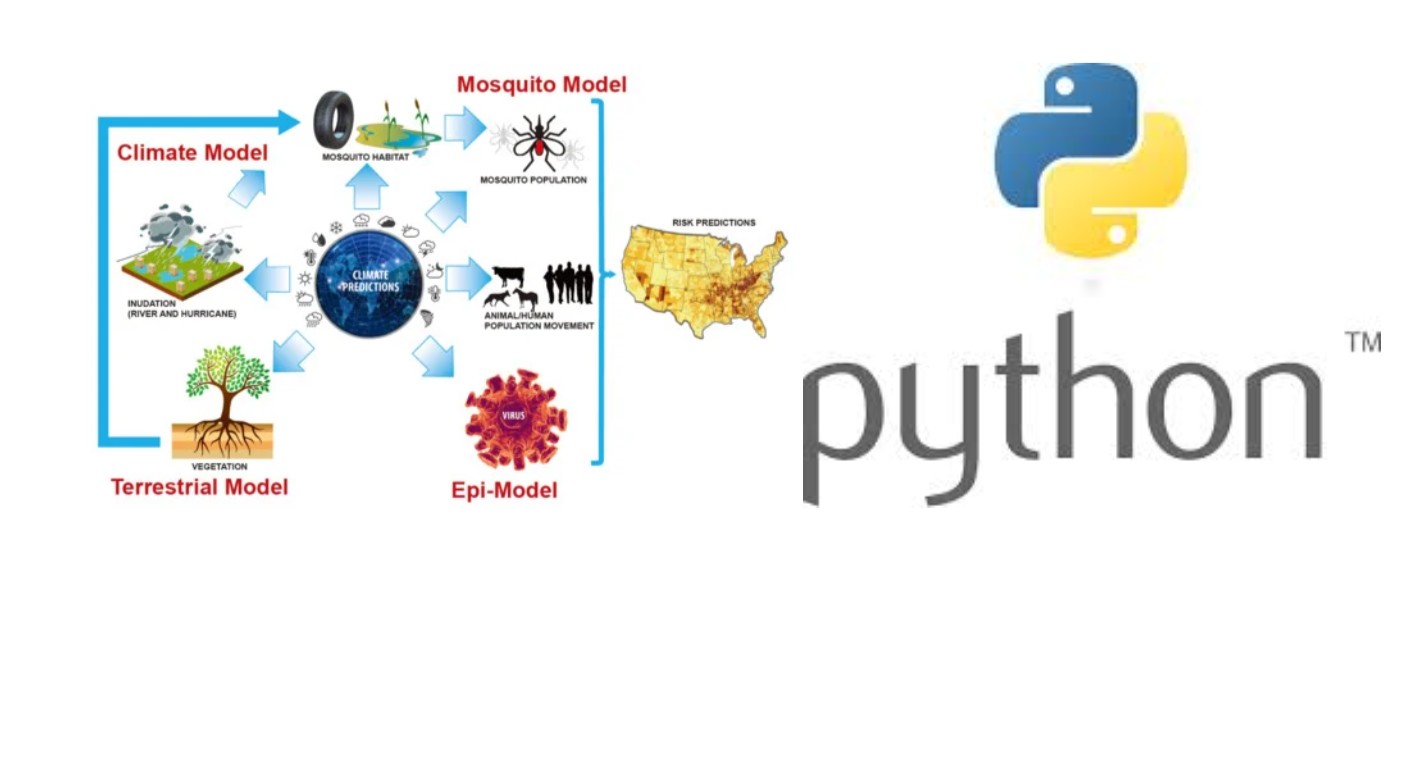
This intensive five-day training course is specifically designed to bridge the gap between core epidemiological principles and modern data science techniques using Python. Participants will learn how to access, clean, model, and forecast the spread of infectious diseases using real-world data, providing them with the practical skills needed to inform public health policy and resource allocation. The curriculum emphasizes both statistical rigor and computational efficiency, ensuring that graduates can build scalable, reproducible forecasting pipelines.
The curriculum rapidly progresses through essential stages, beginning with setting up the Python environment and handling complex health data, including temporal and spatial components. It covers the mathematical foundation of classic epidemiological models (SIR/SEIR), integrates advanced time series methods like ARIMA, and introduces machine learning techniques for prediction and early warning systems. A strong focus is placed on model validation, interpretation, and translating analytical results into clear, compelling narratives and visualizations for public health decision-makers, all supported by hands-on practical sessions throughout the course.
Who should attend the training
· Public Health Analysts
· Epidemiologists
· Data Scientists working in healthcare
· Biostatisticians
· Policy Makers in Health Ministries
· Researchers in infectious disease modeling
· Students pursuing advanced degrees in related fields
Objectives of the training
· Master the Python ecosystem (Pandas, NumPy, Scikit-learn) for managing large public health datasets.
· Apply classic compartmental models (SIR/SEIR) and time series methods to forecast disease incidence.
· Develop machine learning models for early outbreak detection and risk prediction.
· Conduct geospatial analysis to understand the spatial dynamics of disease spread and clustering.
· Evaluate forecasting model performance using appropriate epidemiological metrics and quantify uncertainty.
· Create reproducible analytical pipelines and communicate complex forecasting results clearly to stakeholders.
Personal benefits
· Gain advanced proficiency in Python for statistical and epidemiological modeling
· Acquire highly specialized skills in infectious disease forecasting and risk analysis
· Enhance credibility as a data-driven public health professional
· Develop the ability to independently build and validate predictive models
· Receive a certification of completion that validates specialized analytical skills
Organizational benefits
· Improve the accuracy of disease incidence forecasts, enabling timely resource mobilization
· Enhance organizational capacity for surveillance and early warning systems
· Provide clearer, evidence-based recommendations for disease control and intervention strategies
· Accelerate the adoption of modern, reproducible data science tools in public health programs
· Optimize inventory and distribution of medical supplies based on predictive models
Training methodology
· Interactive Lectures
· Hands-on, Step-by-Step Code-Along Sessions
· Case Studies based on Real-World Disease Outbreak Data
· Group Problem-Solving Exercises
· Immediate Feedback and Q&A Sessions
· Dedicated Time for a Capstone Project Implementation
· Post-Training Support for Project Application
Course Duration: 5 days
Training fee: USD 1500
Trainer Experience
Our trainers are seasoned experts with extensive experience in infectious disease modeling and computational epidemiology. They possess advanced degrees and a proven track record of applying data science to real-world public health crises, often consulting for national and international health organizations. Their practical expertise ensures the course content is grounded in operational reality and cutting-edge research, providing participants with actionable knowledge and effective modeling techniques.
Quality Statement
We are committed to delivering the highest standard of professional development. Our course materials are rigorously peer-reviewed, continuously updated to reflect the latest scientific literature and Python libraries, and taught by certified subject matter experts. We guarantee a learning environment that is engaging, technically challenging, and directly applicable to your public health forecasting needs.
Tailor-made courses
We recognize that specific public health agencies or research teams have unique needs, such as focusing on a specific disease (e.g., dengue, malaria) or integrating with proprietary surveillance systems. This course can be fully customized to address particular disease ecology, data formats, or policy contexts upon request. Contact us for a consultation to design a bespoke training solution for your team.
· Review of core epidemiological concepts (incidence, prevalence,  , transmission dynamics)
· Introduction to the Python Data Science Stack (Pandas, NumPy, Matplotlib)
· Setting up the computational environment for public health analysis (Anaconda, virtual environments)
· Overview of common communicable disease data sources (case reports, sentinel surveillance, syndromic data)
· Practical session: Initializing the Python environment and loading a time series of historical influenza incidence data.
· Deep dive into Pandas: DataFrames, indexing, and merging multiple datasets
· Handling date and time data: Parsing, formatting, and time zone management
· Data aggregation and resampling techniques for standardizing reporting intervals (e.g., weekly, monthly)
· Implementing conditional logic and list comprehensions for efficient data manipulation
· Practical session: Cleaning and merging historical case count data with corresponding demographic data using Pandas.
· Identifying and addressing common data quality issues in surveillance systems (reporting lags, underreporting)
· Techniques for handling missing values in health datasets (Imputation strategies like KNN or mean)
· Outlier detection and smoothing methods for noisy incidence curves (e.g., rolling averages)
· Converting raw case data into usable format for modeling (e.g., weekly incidence rate calculation)
· Practical session: Developing a full data cleaning pipeline function to process raw weekly COVID-19 case counts, including outlier removal and imputation of missing weeks.
· Creating effective time series plots to visualize incidence trends and seasonality
· Generating distribution plots and heatmaps to explore disease spread across age groups and regions
· Using interactive visualization libraries (e.g., Plotly) for dynamic dashboard development
· Analyzing correlations between health outcomes and potential driving factors (e.g., temperature, population density)
· Practical session: Producing a comprehensive EDA dashboard using Matplotlib and Seaborn, visualizing the seasonality and growth rate of a sample disease.
· Theoretical foundations and mathematical formulation of the SIR model
· Expanding to the SEIR model to incorporate the latent (exposed) period
· Numerical simulation of models using Python solvers (SciPy)
· Parameter estimation and fitting the model to observed incidence data
· Practical session: Implementing and simulating both SIR and SEIR models in Python, adjusting the value to observe its impact on the epidemic curve.
· Introduction to traditional time series methods: Moving Average, Exponential Smoothing (ETS)
· Autoregressive Integrated Moving Average (ARIMA) models: Identification, estimation, and diagnostics
· Implementing external factors (e.g., vaccination rates, mobility) via ARIMAX models
· Using the Prophet library for automated forecasting and handling multiple seasonality
· Practical session: Building and evaluating a SARIMA model to forecast the weekly incidence rate of a cyclical respiratory illness.
· Feature engineering for epidemiological ML: Lagged values, population mobility, and climate variables
· Implementing supervised regression models (Random Forest, Gradient Boosting) for next-period incidence forecasting
· Developing classification models (e.g., Logistic Regression, SVM) for binary outbreak/no-outbreak prediction
· Techniques for addressing class imbalance in outbreak prediction datasets
· Practical session: Training a Gradient Boosting Regressor to predict the one-week-ahead case count, utilizing lagged incidence and temperature as predictors.
· Introduction to GeoPandas and handling spatial data formats (shapefiles, GeoJSON)
· Visualizing disease prevalence and incidence on regional maps using Folium or Plotly
· Conducting spatial autocorrelation analysis (Moran's I) to identify disease clustering
· Implementing spatial smoothing techniques to adjust for small area population bias
· Practical session: Mapping the historical spread of a disease across different administrative regions and identifying statistically significant hot spots.
· Standard model evaluation metrics: Root Mean Square Error (RMSE), Mean Absolute Error (MAE), and coverage of prediction intervals
· Cross-validation techniques suitable for time series data (e.g., rolling and blocked cross-validation)
· Quantifying and visualizing forecast uncertainty using prediction intervals and Monte Carlo simulation
· Interpreting feature importance from complex machine learning models (e.g., SHAP values)
· Practical session: Comparing the RMSE and prediction interval coverage of three different forecasting models (e.g., SEIR, ARIMA, Random Forest).
· Principles of data storytelling for public health policy and operational teams
· Designing effective, non-technical visualizations for decision-makers
· Creating reproducible analytical reports and interactive web applications (using Streamlit or Dash)
· Translating forecasts into clear, actionable policy recommendations and intervention triggers
· Practical session: Building a simple web application in Python to display the latest disease forecast and key policy implications.
Requirements:
Terms and Conditions
1. Discounts: Organizations sponsoring Four Participants will have the 5th attend Free
2. What is catered for by the Course Fees: Fees cater for all requirements for the training – Learning materials, Lunches, Teas, Snacks and Certification. All participants will additionally cater for their travel and accommodation expenses, visa application, insurance, and other personal expenses.
3. Certificate Awarded: Participants are awarded Certificates of Participation at the end of the training.
4. The program content shown here is for guidance purposes only. Our continuous course improvement process may lead to changes in topics and course structure.
5. Approval of Course: Our Programs are NITA Approved. Participating organizations can therefore claim reimbursement on fees paid in accordance with NITA Rules.
Booking for Training
Simply send an email to the Training Officer on training@armstrongglobalinstitute.com and we will send you a registration form. We advise you to book early to avoid missing a seat to this training.
Or call us on +254720272325 / +254725012095 / +254724452588
Payment Options
We provide 3 payment options, choose one for your convenience, and kindly make payments at least 5 days before the Training start date to reserve your seat:
1. Groups of 5 People and Above – Cheque Payments to: Armstrong Global Training & Development Center Limited should be paid in advance, 5 days to the training.
2. Invoice: We can send a bill directly to you or your company.
3. Deposit directly into Bank Account (Account details provided upon request)
Cancellation Policy
1. Payment for all courses includes a registration fee, which is non-refundable, and equals 15% of the total sum of the course fee.
2. Participants may cancel attendance 14 days or more prior to the training commencement date.
3. No refunds will be made 14 days or less before the training commencement date. However, participants who are unable to attend may opt to attend a similar training course at a later date or send a substitute participant provided the participation criteria have been met.
Tailor Made Courses
This training course can also be customized for your institution upon request for a minimum of 5 participants. You can have it conducted at our Training Centre or at a convenient location. For further inquiries, please contact us on Tel: +254720272325 / +254725012095 / +254724452588 or Email training@armstrongglobalinstitute.com
Accommodation and Airport Transfer
Accommodation and Airport Transfer is arranged upon request and at extra cost. For reservations contact the Training Officer on Email: training@armstrongglobalinstitute.com or on Tel: +254720272325 / +254725012095 / +254724452588
| Course Dates | Venue | Fees | Enroll |
|---|---|---|---|
| Mar 02 - Mar 06 2026 | Zoom | $1,300 |
|
| May 04 - May 08 2026 | Nairobi | $1,500 |
|
| Jun 01 - Jun 05 2026 | Naivasha | $1,500 |
|
| Jun 08 - Jun 12 2026 | Nanyuki | $1,500 |
|
| May 18 - May 22 2026 | Mombasa | $1,500 |
|
| Jun 01 - Jun 05 2026 | Kisumu | $1,500 |
|
| Apr 13 - Apr 17 2026 | Kigali | $2,500 |
|
| Mar 02 - Mar 06 2026 | Kampala | $2,500 |
|
| Apr 20 - Apr 24 2026 | Johannesburg | $4,500 |
|
| Jun 15 - Jun 19 2026 | Pretoria | $4,500 |
|
| Apr 27 - May 01 2026 | Cape Town | $4,500 |
|
| Apr 13 - Apr 17 2026 | Arusha | $2,500 |
|
| May 11 - May 15 2026 | Addis Ababa | $4,500 |
|
| Jul 13 - Jul 17 2026 | Cairo | $4,500 |
|
| Jun 08 - Jun 12 2026 | Dubai | $5,000 |
|
| Jul 20 - Jul 24 2026 | Riyadh | $5,000 |
|
| Jul 13 - Jul 17 2026 | Doha | $5,000 |
|
| Jun 01 - Jun 05 2026 | London | $6,500 |
|
| Aug 03 - Aug 07 2026 | Paris | $6,500 |
|
| Jun 15 - Jun 19 2026 | Berlin | $6,500 |
|
| May 18 - May 22 2026 | Geneva | $6,500 |
|
| Jul 06 - Jul 10 2026 | Brussels | $6,500 |
|
| Aug 03 - Aug 07 2026 | New York | $6,950 |
|
| May 11 - May 15 2026 | Los Angeles | $6,950 |
|
| Apr 20 - Apr 24 2026 | Washington DC | $6,950 |
|
| Jul 06 - Jul 10 2026 | Toronto | $7,000 |
|
| Aug 10 - Aug 14 2026 | Vancouver | $7,000 |
|

Armstrong Global Institute
Typically replies in minutes